

Surviving Melanoma
By ignoring your dermatologist

In case you didn’t catch the subtitle, let me say it again. In regard to advice about sun exposure:
Ignore your dermatologist.
Of course, that’s just my personal opinion. If he or she is like my dermatologist, it is likely you are getting bad advice about melanoma. Especially about minimizing sun exposure.1 But absolutely DO avoid getting sunburned, as research suggests that can increase your melanoma risk.
Risk Factors
My first interaction with a dermatologist was in Seattle in the mid-1990s. I had a spot on my right temple that I’d keep scratching at, and which would not heal. My wife told me I needed to get it checked out (I doubt I would have done so if she hadn’t told me to).
It turned out it was a basal cell carcinoma. The doc scraped it off, and that was that.
The dermatologist told me was I almost certainly assured of getting another skin cancer at some point in my future, because I ticked off all of the boxes for risk factors:
Fair eyes (blue),
Fair hair (sandy brown, now gray, blond when I was young),
Fair skin (my unexposed skin is neon white in direct sunlight),
Irish ancestry (guilty as charged, but just barely: despite an Irish surname, only about 1% of my DNA is from my sole Irish immigrant ancestor, who came to America in the early 1770s), and
A history of sunburns (including some pretty nasty ones).
If you’ve had a skin cancer diagnosis, chances are you, too, checked off the majority of these risk factors.
Unwelcome News
In 2003, I moved to Idaho, and in early 2004 I decided to find a new dermatologist for a cosmetic procedure. I was seen by Janice, who was a former nurse with decades of experience. She had just joined the practice after recently earning her Nurse Practitioner degree. Since I was a new patient, she took my history. When she was done, she told me to take off my shirt.
I complied, and she started by looking things over in the front. A few moles that were a little suspect, but nothing all that concerning. I was told to turn around. I did so.
After a very brief look, she exclaimed “Oh, my God!” (clearly, not the ideal bedside manner, but she’d only been at this for a few days). “I’ll be right back.”
She returned with the “real” dermatologist, the doc. I got a quick introduction, and she escorted him to my posterior. “Hmmm..” he said, “That one… that one, that one… and that one! Good work!”
Turning me he said “There are some moles that we are concerned about that should be removed. If you agree, Janice will do that now.” Janice’s “Oh my God!” comment suggested to me that it was best if I agreed. So I did, no questions asked.
Before digging in, she checked my lymph nodes and found nothing to suggest that they were involved, so hopefully if any turned out to be cancerous they likely hadn’t yet metatasized. After she was done, I made a follow-up appointment for the cosmetic procedure.
The next day, I got a call from the doctor.
“Hello,” he said, “I guess you’re wondering why I’m calling?” To which I replied, “Well, I know it’s not because my check bounced!”
He proceeded to tell me I needed to come back in as soon as possible. One of the moles was confirmed to have been a melanoma, and while Janice had gotten all of it, the clear margins were not quite wide enough. She’d need to go back in, open me up again and carve some more meat out of my back.
When most types of skin cancers are removed, they try to get a few millimeters of clear margins. With melanoma, they need centimeters to better assure that they get it all. So I ended up with some pretty big scars on my back. It looks like I’d been on the losing end of a very nasty knife fight.
I was told that I had a Stage III melanoma that was moderately aggressive, and that two of the other moles were deemed to be dysplastic nevi, meaning they were looking as though they were eager to become part of the melanoma club as well.
With that out of the way, I was told that the sun was now my enemy, and to cover up, slather up, minimize time in the sun, yada, yada, yada.
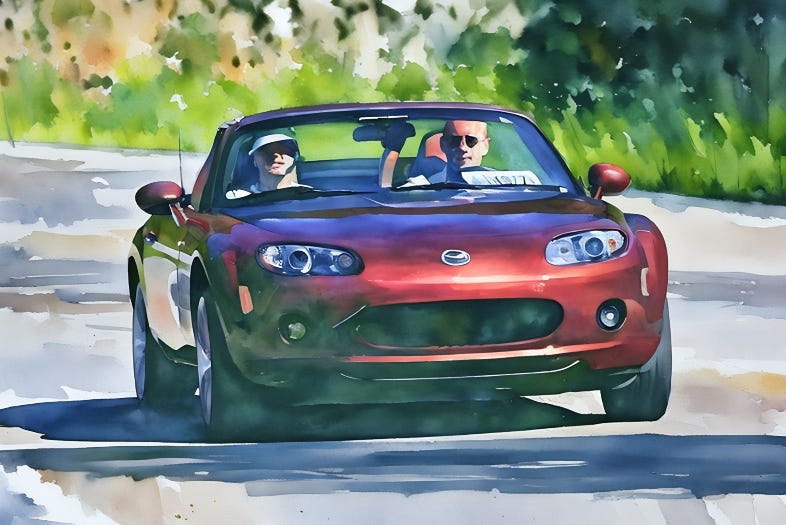
I took it all to heart, buying lots of SPF clothing and loading up on sunscreen, including the white stuff that made me look a bit like Marcel Marceau. I stopped putting the soft top down on my roadster, and tried to figure out how to bicycle in the heat while wearing so many clothes.
Healing Journey
The next thing to do was to try to understand why I got melanoma, and what I could do to prevent a future recurrence. That started my 20+ year healing journey, which eventually became a quest to better understand the two things that are likely to cause the deaths of most of us: heart disease and cancer.
When most people end up with a diagnosis of heart disease or cancer, they panic. That’s mainly due to decades of programming by popular media. It doesn’t help that their physician emphasizes the potential seriousness, and is usually insistent upon acting quickly. I decided to learn what I could about both diseases in order to avoid being forced into a situation where I was likely to end up making decisions based upon fear.
Back at the ranch, after hearing my diagnosis, my wife, a former nurse, did some research. She said my diagnosis gave me about a 50% of being alive in 5 years. What she didn’t say was that the odds didn’t improve thereafter, but I kind of guessed that. Not happy news, but I try not to worry too much about things I have no control over. And I understood her need to plan for all possible outcomes, including the possibility of her having to fly solo in the near future. It also helped me grasp how serious things were.
Looking for Answers
I started looking everywhere for answers to why cancer had chosen me? After all, I bicycled a LOT and ate a reasonably good diet, at least better than most of the people I knew (who didn’t have cancer). And most everyone thinks if they are active and eat well that their chances of getting cancer, or any chronic disease, are very slim. I used to think that, too.
Back then, my primary resource of health information was Dr. Mercola’s newsletter. Dr. Mercola was an osteopath turned naturopath, and an advocate for avoiding disease by taking control of your own health. It was through him I learned of Dr. Michael F. Holick’s groundbreaking Vitamin D research.2
Dr. Holick stated that sun exposure wasn’t a cause of melanoma: that it was fairly rare in outdoor workers, but it was very common among teachers and office workers. He presented a very compelling argument based upon significant detailed research that avoiding UV radiation was counterproductive, especially because it was essential for your body’s production of Vitamin D.
After reading his book, I believed that he was right, and that my dermatologist was just plain wrong about pretty much all of his recommendations. Dr. Mercola detailed how it was important to get lots of mid-morning sun exposure early in the spring, to slowly build up a base tan. He also advocated that if you were going to spend a lot of time outdoors, to do so when the sun was lower in the sky. Low sun angles allowed for the atmosphere to filter out elements of light that are responsible for burning.
I later learned that sun exposure can be problematic if you over-consume seed oils, because they can easily oxidize. And oxidized fats incorporated into your skin cells can make you more susceptible to burning.
To lower your risk of burning, it is necessary to severely limit consumption of Omega 6 fatty acids, and increase your intake of Omega 3 fatty acids. Once you do this, it takes about eight months for your body to get rid of all of the offending oxidized fats. During that time it’s a good idea to be extra careful about getting too much sun.
After twenty one years of following Dr. Mercola’s sage advice (and ignoring that of my dermatologist), I’ve had no cancer recurrence, driven thousands of miles in my roadster with the top down, and ridden many thousands of miles on my bicycle. Including three summers where my wife and I tagteam-bicycled throughout the United States. I would only use a little bit of 15 SPF sunscreen, and then only if I was going to be in full midday sun for an hour or longer. We tried to get our riding done early in the day, and spent our afternoons in the shade or in our camper.
No Metastasis
I was fortunate that my melanoma had not metastasized to other parts of my body. If it had, the dermatologist whom I ignored would have wanted to pass me off on his colleague, the oncologist. The oncologist, in order for insurance to reimburse for his services, has to follow the standard of care: cut, burn and/or poison (surgery, radiation, chemotherapy). Until those three things are attempted, everything else is verboten, at least if you want insurance to pay for it.
There was a meta-analysis done several years ago that the average net gain from all those cancer chemotherapy treatments was less than a two month increase in five year survival rates. Two months of extra life, on average. Which cost you months of pain, nausea, misery, changes to taste, and other fun side effects that would greatly diminish your quality of life during treatment, not to mention the actual cost of those drugs. Personally, I don’t think that is a rational choice for most people to make, but then my perspective comes from years of reading dozens of authors on the topic, not from a moment of fear upon first hearing the dreaded C-word diagnosis.
If I were to have any cancer today, metastasized or not, I would start by going to my functional med doc for his advice. And I’d probably start some IV Vitamin C therapy to boost my overall health, and perhaps an IV Myers Cocktail,3 to assure that my health woes weren’t related to a simple nutritional deficiency. Docs in this country have to be very careful about how they treat you, because the cancer cartel does not like anyone moving in on their turf, so we wouldn’t consider those IVs as a form of cancer care. It would just be nutritional support (that just happens to be more helpful than many cancer therapies).
I’d probably also seek out treatment by someone who has trained under Dr. Jerry Tennant. He views cancer as an energy problem, caused by the polarity being flipped in a part of your body.4 He utilizes a device for measuring voltage in different parts of your body, looking for areas of low voltage. When an area of low voltage is found in a circuit where you are experiencing cancer, he traces your internal wiring to determine what is causing the problem, and then uses various methods to fix the problem and restore the correct polarity and voltage. Once that is accomplished, the body heals itself.
My fallback position would be to visit Dr. John Bergman’s clinic in Tijuana, Mexico. They’ll do a lot of alternative stuff to try to coax your body back to health, and they have MDs who can do appropriate surgery, radiation and chemotherapy, when it’s necessary to buy some time for the alternatives to work. It’s usually not the cancer that kills you, it’s the cancer cutting off the blood supply to a vital organ that does. So there are times when standard of care therapies are needed to prevent that from happening.
If you are concerned about a possible future cancer diagnosis and how to deal with it, in addition to Tennant’s book, I’ve included in the footnotes a selection of the better recent books that I’ve read on cancer.5 Because cancer is several different diseases, and not just one specific disease, there are a range of therapies that will help some cancers and not others.
It’s not a topic to try to navigate on your own. Hopefully you can find a doctor to help advise you, who doesn’t limit their advice to only what insurance will pay for. Though what anyone can afford is a big part of the decision making process.
Likely Cause
Before moving to Idaho, my office near Seattle was an interior office, fluorescent-lit, with no source of natural light. It was small, but contained two PCs, an oversized monitor, a laser printer and a wide format inkjet printer. Along a shared wall in the attached room behind me was the department’s high speed digital copier and high speed laser printer. The copier actually had its own 50 amp power supply, while everything else was run on a few 20 amp circuits.
My theory, having had the luxury of contemplating this for decades, is that the primary cause of my melanoma was likely somehow related to EMF exposure, given how many sources I was surrounded by, and the increased prevalence of melanoma among office workers.
A secondary cause was likely stress. The stress of selling our first home in Seattle, the stress of buying a new house in a new state where we knew nobody, stress caused by last minute problems getting the money to complete the sale, the stress of finding a new job (my wife had a job, since she had been recruited to work there), the stress of moving (including driving through forest fires on the way there), the stress of making new friends, the stress of moving into a neighborhood full of very recent immigrants (the majority were Russian or Ukrainian), etc…
Conclusion
It seems the current non-mainstream view of skin cancer is that the primary dietary contributor is excessive Omega 6 fats, especially from seed oils and grain-fed livestock. Consuming a healthy balance of Omega 6 to Omega 3 fatty acids is your best means of minimizing that risk.
Sunburns are the main controllable risk factor for melanoma, and I’m not talking about when you get a little red from staying out in the sun a little longer than you should. More serious burns, to the point of blistering, are far more likely to increase your risk of melanoma.
Since my story constitutes a sample of one, some people will conclude that I have survived simply due to blind luck. After all, there’s 50% chance that I could be either right or wrong.
Others will suggest my experience is all placebo effect. And I agree that’s a possibility. After reading Dr. Holick’s book, I did truly believe, based upon his detailed research, that he had set me on the right path for dealing with my melanoma.
What is clear is that I beat the odds, and my experience set me on a healing journey where I’ve beat the odds with other serious health challenges. Not only my own, but also those of my loved ones and many people whom I’ve met along the way.
Perhaps I’ve just been on a very long lucky streak?
I certainly felt lucky when I made it to 5 years, post-melanoma. And again at ten years. And fifteen. Right now, 21 years later, I’m thinking there was probably more than luck to my surviving this long. I’m hanging out at the far edge of the bell curve, and there is something to being that significant of an outlier.
My advice is to do your own research and decide for yourself how to overcome any personal health obstacles that might present themselves. Doctors should be used for advice, and not relied upon to make decisions for you.
That was how things worked when my grandparents developed chronic diseases in the 1960s, and they all lived well into their late 80s and 90s, without nearly so much of the hospital drama that seems commonplace today. But then drugs and surgery weren’t quite the popular treatment options then as they are now. It seemed back then that there was more faith that the body could heal itself, if we could just help nudge it in the right direction.
MY STANDARD ADVICE for triangulating the truth:
BEWARE OF THE BENEVOLENCE OF BILLIONAIRES:
Most billionaires become such by exploiting you, not by thinking of your best interests. Viewing the world through this lens may literally save your life!
Disclaimer: I write about my personal experiences, and what works for me may not work for you. I have no healthcare training, but I’ve been reading passionately on healthcare since early 2004. I have gained my own education from published researchers, rather than relying upon obtaining advice from the medical orthodoxy. None of my opinions on medical matters should be construed as treatment advice.
The UV Advantage (2005) by Dr. Michael F. Holick, PhD.
Ibid.
An IV cocktail of vitamin C, magnesium, calcium, B vitamins, B12, and more.
Healing is Voltage: Cancer’s On/Off Switches: Polarity (2015) by Dr. Jerry Tennant.
Cancer and the New Biology of Water (2019)by Dr. Thomas Cowan, or Lies are Unbekoming’s book summary.
The Metabolic Approach to Cancer (2017), Dr. Nasha Winters and Jess Higgins Kelley.
Radical Remission (2015) by Dr. Kelly Turner, or Lies are Unbekoming’s book summary.
“Doctors should be used for advice, and not relied upon to make decisions for you. “ This. Exactly this. You, as the patient, have the benefit of viewing allopathic medicine as one modality, in the toolbox of many, for recovering or maintaining health. And with the corporate takeover and exploitation of allopathic medicine and exclusion of nearly every other modality, it has never been truer. Limiting insurance coverage to mainly one modality does not put the patient first.
I just found your stack and enjoying it! 11 years ago I had a melanoma removed from the side of my neck. In one of the follow ups, after my demonologist asked if I was wearing sunscreen, he says, “yea, but I’m not convinced the sun has much to do with it. I see people with skin cancers between their toes and all kinds of places the sun never gets.”
My journey is similar to yours and now I do not wear sunscreen unless it’s the middle of the day and I’ll be out a while. Fear of the sun is not healthy!